Showing posts with label Rana Rulers. Show all posts

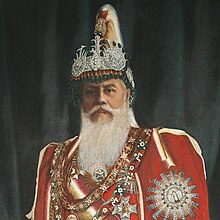
Bhim Shamsher


Written by: Sona Roka Magar

Bhim Shumsher JBR was the 14th Prime Minister and 6th Rana  Prime Minister of Nepal. He was born on 16th April 1865 Thapathali Durbar Kathmandu. Before becoming prime minister, he was the heir apparent (with the rank of field marshal) from 1907 to 1929. Bir Shumsher ruled Nepal from 26 November 1929.

Family and Early life

Bhim Shumsher was 6th son of Dhir Shamsher Rana, the youngest brother of  Jung Bahadur Rana. Bhim Shumsher's son, Padma Shumsher Jang Bahadur Rana, ruled Nepal from 29 November 1945 to 30 April 1948; his other sons held prominent state positions until 1951. Bhim Shumsher joined the Nepalese Army as a lieutenant colonel in 1868. He become a colonel in 1879. Bhim Shamsher was aide-de-camp  to King George V during his visit to Nepal in December 1911, and he was crowned ruler of Nepal on 26 November 1929.Bhim Shumsher became Field Marshal of Nepalese Army on 26 November 1929, Honorary Major General of the British Army on 4 April 1930, Honorary Colonel of the 4th Gorkha Rifles on 4 April 1930, and Honorary General of the Chinese Army on 23 February 1932.


His major achievement and rule

Bhim Shumsher JBR plays an important role in abolishing capital punishment. Bhim Shumsher built several district hospitals, extended the drinking-water pipelines in eastern Nepal, and built public roads and bridges. He was the one who make Saturday as a holiday in Nepal. He introduced fixing working hours from 10:00 AM to 4:00 PM on weekdays, protecting tenant farmers from land-reform, abolishing duties on cotton and salt, ending the pasture tax. Bhim Shumsher upgraded the middle schools of Bhaktapur and Kathmandu's Patan district to high-school standards.
Foreign Relation
Bhim Shumsher was allied with Kuomintang China in the north and the British Raj in India in the south, both of whom had interests in Nepal. He received the Delhi Durbar Medal from Britain in 1911 and the Order of the Sacred Tripod on 23 February 1932 from the Republic of China.
Bhim Shumsher contained the British interests in Nepal to economic support in exchange for Gurkha soldiers for the British Army. He invited William Birdwood, commander-in-chief of the British forces in India, to Kathmandu in 1930. Bhim Shumsher visited Calcutta in 1931 to meet with viceroy Lord Irwin about their relations with Tibet, since the British wanted to develop a trade route with Tibet via Nepal. Relations between Tibet and Nepal were deteriorating, however, and the British wanted to mediate the dispute. After his visit to India, he was honored by Italian and Chinese governments.
The threat of an armed Tibetan-Nepalese conflict arose in the spring of 1930. Relations between Tibet and Nepal had soured since August 1929 because of what Bhim Shumsher saw as Lhasa's maltreatment of S. Gyalpo, a Tibetan-Nepalese who was arrested in the city; Bhim Shumsher's diplomats said that Gyalpo was a Nepalese subject, and the Tibetans disagreed. Gyalpo escaped from custody, and sought shelter at the Nepalese embassy in Lhasa. Tibetan police entered the embassy and took Gyalpo away; the move outraged Bhim Shumsher, who ordered the mobilization of troops in preparation for war against Tibet in February 1930.
Tensions between the countries placed a heavy burden on Tibetan military defense, and Chiang Kai-shek informed the 13th Dalai Lama of his willingness to send troops and officials to assist the Tibetans in their fight against the Nepalese. Although the Dalai Lama tactfully declined what he saw as the entry of Han Chinese troops (and officials) into Tibet, Chiang Kai-shek continued to display goodwill towards the Tibetans by promising to exercise diplomatic pressure on British India and Nepal in the Tibetan-Nepalese dispute.
The head of the Mongolian and Tibetan Affairs Commission and Chiang Kai-Shek's key deputy, Ma Fuxiang, arranged for a diplomatic initiative with Nepal on behalf of Chiang. Chiang's officials reached Kathmandu via India in September 1930 to meet Bhim Shumsher, who was informed that they came to "offer the services of the Chinese government to settle the dispute." The delegation presented Bhim Shumsher with gifts from Chiang Kai-Shek which included porcelain, ancient Chinese textiles, lacquerware, jade, ivory, and other Chinese artifacts. Bhim Shumsher repudiated the Chinese government's claims of involvement in any issue between Tibet and Nepal, however, and noted that British-led mediation had already helped reach a peaceful settlement. The result suggested to China that Chiang Kai-shek's efforts led to the peaceful resolution between Tibet and Nepal, and he had protected Chinese sovereignty.
Bhim Shumsher continued to develop diplomatic relations with Kuomintang politicians during his rule, and balanced relations with the British Raj in India. He also developed diplomatic relations with Japan and several European powers.
Award Received
1) Grand Master award of the Most Refulgent Order of the Star of Nepal.
2) Royal Victorian Order
Cause of Death
After ruling for several years, Bhim Shumsher JBR suffer from diseases and died on 1 September 1932.

Adopted from: https://en.wikipedia.org/wiki/Bhim_Shamsher_Jang_Bahadur_Rana

Chandra Shamsher Rana


Written by: Sona Roka Magar

 Chandra Shumsher was the 5th Prime Minister of Nepal from the Rana dynasty. He was born on 8 july 1863. He was 13th Prime Minister of Nepal and Maharaja of Lamjung and Kaski. Chandra Shumsher JBR is credited with several reforms including the abolition of slavery and the Nepal-Britain Treaty of 1923, which recognized Nepal as an independent nation and an ally of Britain.

Family life and early life 
Chandra Shumsher was the 6th of the 17 sons of Dhir Shumsher Rana (the youngest brother of Jung Bahadur Rana) through his wife Nanda Kumari,. He became to be the first Nepalese Prime Minister who had passed matriculation examination.  
After the demise of his eldest brother Bir Shamsher in March 1901, he became the Commander in Chief of the Nepalese Army under the premiership of his brother Dev Shamsher. Chandra Shamsher was afraid about the rise in public awareness and the demand of democracy by Nepalese people due to the liberal policy of Dev Shamsher. Hence, Chandra Shamsher orchestrated the plan to seize the power for himself in June 1901. Although, Chandra Shamsher opposed the reforms of Dev Shamsher, later on, he himself willingly and unwillingly brought many reforms in Nepal after he visited Europe.
Chandra Shumsher Jung Bahadur Rana had 11 children: 
1) Khagaraja Divyeshwari Rajya Laxmi 
2) Field Marsha Mohan Shumsher 
3)Baber Shamsher  
 4)Kaiser Shamsher 
5)Singha Shamsher 
6) Commanding General Krishna Shamsher 
7)Major-General Vishnu Shamsher 
8)General Shanker Shamsher  
9) Lt.-Gen. Madan Shumsher  
10) Khagaraja Divyeshwari Rajya Laxmi 
11) Maharajkumar Badri Shumsher 
Major Achievement Of Chandra Shumsher Jung Bahadur Rana 
During the 28 years of his rule, Chandra Shumsher held the firm control of domestic as well as the foreign policy of Nepal.Seto Bagh, a historical novel set on the early days of Chandra Shumsher, depicts him as an ambitious and cunning young man with an excellent command upon English language.
After his return from the European tour, he is said to have been embarrassed by the backwardness of his country, so he executed some noteworthy reforms. He abolished Sati custom and made it illegal for a person to be killed for witchcraft. He also abolished slavery with the money from the treasury of Pashupatinath temple. He built the first college of Nepal, Tri Chandra College in 1975 B.S. He established several canals like Chandra Nahar, the oldest canal of Nepal located in Saptari and established hospitals throughout Nepal. He built Singha Durbar, the largest palace in Asia with over 1200 rooms. , was built by him as well. The city of Chandranigahpur in Rautahat district was named after him.
The first railway service in Nepal, Nepal Government Railway from Raxaul to Amlekhganj, started its service in his tenure. These reforms, however, were mostly brought for the benefit of his family.
He was the second Nepalese Prime Minister to visit Britain and tour Europe after Jung Bahadur Rana. In Britain, he stayed in Mortimer house and was entertained by His Majesty Edward VII. He also observed naval exercises of British Royal navy and in one of the warships, he met the French President under the arrangement of Edward VII. On 24 June, the University of Oxford conferred the honoris causa degree of Doctor of Civil Laws on him.He provided monetary and military assistance to Britain in the First World War, as a result of which Nepal received a huge sum of monetary assistance and the friendship became even more cordial after the successful conclusion of the Nepal–Britain Treaty of 1923, which recognised Nepal as an independent nation and an ally of the British Empire.
Award Received 
1) Empress of India Medal - 1877
 2) Delhi Durbar Medal - 1902
 3) T'ung-ling-ping-ma-Kuo-Kang-wang (Truly valiant Prince, Commander-in-chief of foot and horse) - 1902
 4) Knight Grand Cross of the Order of the Bath (GCB) - 1905
 5) Knight Grand Commander of the Order of the Star of India (GCSI) -1905
 6) Knight Grand Cross of the Royal Victorian Order (GCVO) - 1911
 7)Delhi Durbar Medal - 1911
 8) Knight Grand Cross of the Order of St Michael and St George (GCMG) - 1919
 9)Grand Officer of the Legion d'Honneur -1925
 10)Grand Cross of the Legion d'Honneur - 1929

Causes of Death 


Chandra Shamsher suffered with tuberculosis and followed a strict diet regimen of rice and black lentils exclusively, as a result he was extremely thin and is sometimes called "Fiste Maharaj". At the age of 66, he suffered from diseases and died on 26 November 1929.
Adopted from: https://en.wikipedia.org/wiki/Chandra_Shumsher_Jang_Bahadur_Rana

Dev Shamsher


Author: Sona Roka Magar

Dev Shumsher Jung Bahadur Rana was the 12th prime minister of Nepal. He was born on 17 July 1862. He was Maharaja of Lamjung and Kaski. In the annals of political history, he is remembered as Nepal's 'most liberal' prime minister, considering he came from the Rana dynasty known for their autocratic rulers who presided over the kingdom from 1846 to 1951. He was prime minister of Nepal for only 114 days in 1901. 


Family life

Dev Shumsher Jung Bahadur Rana  was the fourth of 17 sons born to the Chief of the Army Dhir Shamsher Jung Bahadur Rana (a younger brother of Jung Bahadur Rana) by his third wife, Rani Nanda Kumari, daughter of Kazi Hemdal Singh Thapa (sister of Commanding Colonel Keshar Singh Thapa). Dev Shumsher was adopted at a very young age by his father's childless elder brother, General Krishna Bahadur Kunwar Ranaji and was raised by him and his wife. As the adopted child of general Krishna Bahadur Rana, who was governor of Palpa, Dev Shamsher had a lavish upbringing compared to his natural brothers. Only  festivals and family gathering,  Dev Shumsher can meet his own sibling. The Shumsher were poorer than the Jang and other cousins, so to ease the burden on Dhir Shumsher.Since he was much richer than his brothers, they envied him. He spent the majority of his time in their palace, Thapathali Durbar. 
Dev Shumsher had 12 sons and 3 daughters. His principal wife was Badamaharani Karma Kumari, Maharani Krishna Kumari (daughter of the King Surendra, in fact, Dev Shamsher was the only amongst the 17 Shamsher brothers to marry a princess from the royal family of Nepal) and Rani Ganesh Kumari.
Major Achievement Of Dev Shumsher Jung Bahadur Rana 
Dev Shumsher was  known as a reformist. He wanted to abolish slavery. He started building schools to introduce universal education and launched many social welfare schemes, apart from being a firm anti-corruptionist. He introduced gambling, bhajans and silent movies in his less than five-month rule. He also made improvements to the arsenal at Nakkhu (south of Kathmandu). A democratic person, he took the advice of his nephew General Gehendra Shumsher and decided to establish a parliament and built a big hall in his Thapathali Durbar like his uncle, Prime Minister and Chief of the Army (Marshal) Jung Bahadur. 
He proposed a system of universal public primary education, using Nepali as the language of instruction, and opening Durbar High School to children who were not members of the Rana clan. He organized a ladies court like his late uncle Jung Bahadur. He was the first person to introduce the newspaper to Nepal, Gorkhapatra, which is still the national daily. He saw Japan as his model. He chose an advanced Asian nation for learning probably because of some similarities between Nepal and Japan rejoining their cultural and then political situation. It was Dev Shumsher who planned to send Nepali youths to Japan for higher studies.
This all-encompassing, accommodating disposition of the exiled prime minister is perhaps reflected in the curation of the exhibition too. In his fifties, he had a stroke and wrote to his brother to grant him the wish to visit Nepal once before he dies. His brother wrote back saying, "Just as no forest can contain two tigers, no one scabbard two swords, so there is no place in Nepal for you and me." 
Cause of Death
 Dev Shamsher ruled for two months in 1901 and was the shortest serving Rana was, he was deposed by his brothers because of his open display of guilt for what has happened during the coup. Dev Shumsher was forced into exile in British India. Upon his arrival, he was given two options: a place in Delhi or Mussoorie. Dev Shumsher chose the latter as the rolling mountain scenery most closely resembled the home he left behind. There he built a palace again, the famous Fairlawn, and began a new chapter with his twelve sons, four daughters and an array of concubines or talimas. Dev Shumsher Rana died " a mysterious death by his own gun" shortly thereafter on February 20, 1914.


 Some Parts are Adopted from: https://en.wikipedia.org/wiki/Dev_Shumsher_Jang_Bahadur_Rana

Bir Shamsher J.B.R


  Author: Sona Roka Magar

Bir Shumsher Jung Bahadur Rana was the 11 prime minister of Nepal and 3rd Rana Prime Minister. He was born on 10 December 1852. Bir was born to the chief of the Army Dhir Shamsher Jung Bahadur Rana, younger brother of Jung Bahadur Rana. He is remembered as a statesman. Bir Shumsher's  mother died as soon as he was born and he was taken care by Putali Maharani, wife of Jung Bahadur. He spent his childhood at Thapathali Durbar and was known as Kailay in his childhood by Jung Bahadur Rana.He was a great builder and a lover of music.


Major Achievement Of Bir Shumsher Jung Bahadur Rana 
 He served from 1885 to 1901 and was invested as Tung-ling-ping-ma-kuo-kang-wang in 1889. Bir Shumsher  made important reforms and infrastructure improvements. During his regin, he introduced the system of 'daudaha' to check corruption, leakage of revenue in districts and to remove flaws in the administrative system. He also divided Nepal into 35 districts which were followed till 2018 BS. Bir Shumsher also discouraged the custom of Sati. While in power, he brought piped water to the Kathmandu Valley, built a suspension bridge at Kulekhani, English was taught in schools and hospitals like Bir Hospital which is still working, were built. He reorganized land tax and created a better administrative body. He sent a large number of troops to the British. The British gave him the title of Knight Grand Commander of the Order of the Star of India on Queen Victoria's Diamond Jubilee. He was an earnest ruler.

He started a new line of succession to the Prime Ministership of Nepal, excluding all others except the legitimate sons of Dhir Shumsher. He established Durbar High School, Bir Hospital, Bir Tower (Ghanta Ghar), Pathshala (School) and a sanitary system. He provided a good supply of drinking water to the towns of Kathmandu in 1891 and Bhadgaon in 1895. He established the Bir Library for the collection and preservation of valuable books and manuscripts, the postal system was reformed and many roads of Kathmandu were broadened. He sent 5 students from Nepal to study Engineering in Japan, his son Gehendra Shamsher also known as first scientist of Nepal was also one  of the 5 students. He also sent 10 students to India in order to learn Sanskrit.
Award Received 

1) Prince Albert Victor
2)  Duke of Clarence
3) The ill-fated Archduke Franz Ferdinand
4) Order of the Star of India
Causes of Death 
 Bir Shumsher Jung Bahadur Rana suffered from diseases and died in 5 march 1901, after ruling the country for over 15 years.
Adopted from: https://en.wikipedia.org/wiki/Bir_Shumsher_Jang_Bahadur_Rana

Ranodip Singh Kunwar


Author: Sona Roka Magar

 Ranodip Singh Kunwar was the second Prime Minister of Nepal from the Rana dynasty. He was born on April 3 1825.He was born as seventh son of Kaji Bal Narsingh Kunwar from his second wife Ganesh Kumari Thapa, daughter of Thapa Kazi General Nain Singh Thapa.Jung Bahadur died in 1877 and his brother Ranodip Singh Rana became new prime minister. Ranodip gave continuity to Jung Bahadur's foreign policy, but his tenure was short-lived. After Jung Bahadur's death, conspiracy and ugly power struggle among different groups within the Rana clan started and intensified. 

Major Achievement of Ranodi Singh Rana


Deeply pious, Ranodip Singh composed several devotional hymns and was granted a personal salute of 15 guns from the British in 1883 and the title of Tung-ling-ping-ma-kuo-kang-wang (Truly Valiant Prince; commander of foot and horse) from the Guangxu Emperor in 1882.

Award Received 

1) knight grand cross of the

 order of the bath.

2) Knight award cross of the 

Royal Victorian Order. 

3) Fellow of the Royal 

Geographical Society.

Cause of Death 

Prime Minister Ranodip Singh Rana was 

assassinated by his own 

nephews in 1885 following which

 Bir Sumsher Rana took over power. 


Adopted from: https://en.wikipedia.org/wiki/Ranodip_Singh_Kunwar

Jung Bahadur Rana

Jung Bahadur Rana was born on 18 June, 1817 AD in Thapathali, Kathmandu.Originally, his birth name was Bir Narsingh Kunwar. He was the eldest son of Kaji Bala Narasingh and his younger wife Ganesh Kumari. Bal Narsingh Kunwar was appointed a bodyguard of King Rana Bahadur ShahJung Bahadur Rana was prime minister of Nepal and virtual ruler of Nepal from 1846 to 1877, who established the powerful Rana dynasty of hereditary prime ministers, an office that remained in his family until 1951.Jung Bahadur Rana died on 25 February 1877 at the age of 59 in Patharghat, Rautahat.
Personal Life 
In 1853, Jung Bahadur Rana married Bada Maharani Hiranya Garva, who was the daughter of chief minister Fateh Jung Shah. They had four daughters who were married to royal princes. She also brought up Jung Bahadur Rana’s infant son Padma Jung, as the mother passed away during birth in 1857.He was known to have had at least 13 wives and numerous mistresses. Among his wives were Ganga Maharani who was a princess from Coorg, daughter of Rana Shere Shah who was called Ramri Maharani, a Magar girl named Mina Rani, and yet another wife called Misri Maharani.In 1877, he set out to hunt with three senior wives and two junior wives. However, he fell ill and died on 25th February 1877 on the banks of river Bagmati in Pattharghatta. His senior wives Bada Maharani Hiranya Garva Kumari, Antaree Maharani and Ramri Maharani committed Sati, while the young wives were persuaded to stay back and take care of their children 

Early Life of Jung Bahadur Rana


His father, Bal Narsingh Kunwar was the personal bodyguard of King Rana Bahadur Shah, and was awarded the post of ‘Kaji’. His mother, Ganesh Kumari, was closely related to the respected Thapa family. The influential position of his parents allowed him to enter the royal court at a young age.At the age of sixteen, Jung Bahadur Rana joined the military, when Nepal was under the leadership of his maternal grandfather Bhimsen Thapa. However, with the loss of power of Bhimsen Thapa, he lost his job as well as property.Following this event, he went on a journey spanning north India for a few years and returned to Nepal in 1840.
Rise of Jung Bahadur Rana
In 1840, upon his return to Nepal, he was made captain in artillery. The following year he was offered a post as the personal bodyguard of the King and in 1842, took up the position of Kaji in the palace.In 1946, he obtained control over the government after killing a usurper, Gagan Singh, who had plotted with the queen to elevate himself as Prime Minister and make the queen’s son as the King, by assassinating Jung Bahadur Rana. The plot was exposed and Jung Bahadur Rana exiled the King and Queen. He was then given the post of prime minister for life.By 1850, he had eliminated his major enemies and established control over important administrative matters. His family and close ones were appointed in pivotal positions at the royal court. Between 1850 and 1851, he visited England and France. He was known to have had good relations with the British throughout his life.Jung Bahadur Rana in an attempt to revise the old penal code, advised his officials to amend the nation’s then existing legal system into a unified body of laws that included procedures and frameworks for understanding and acting in the event of various civil and criminal matters. In 1854, the ‘Muluki Ain’ was completed and included matters like revenue, land, caste disputes, marriage and family law.He was a skillful diplomat and this helped Nepal to stay independent even while India was under the control of the British during his time. At the time of the Indian Mutiny in 1857-1858, he supported the British army with a battalion of Gurkha soldiers.He worked towards the modernization of the country and was highly influenced by European architecture and sense of fashion. Jung Bahadur Rana tried to bring about reform in Nepal by improving administration. He strived to abolish the custom of ‘Sati’, self-immolation of wives at the husband’s pyre.In 1856, a special decree granted complete authority in all judicial, administrative, civil affairs as well as foreign relations to him, as Prime minister. Additionally, he was made the King or ‘Maharaja’ of Kaski and Lamjung districts.In 1858, he was bestowed the honorary title ‘Rana’ by King Surendra. The prime ministers who descended from his family later added his name to theirs and his family went to be known as ‘the house of Ranas’.Upon being given the position of Prime Minister for life, he felt it was his duty that the state should be succeeded by an able adult and thus he created the order of succession in a way that is not passed from father to son but between brothers within the family. In the second generation it would be passed among the sons of his brothers as per the age in a similar manner.He remained Prime minister until 1877 and had supreme authority over all matters of the state. After his death, he was succeeded by his brother Rana Utdip Singh.

Major achievements of Junga Bahadur Rana 

Administrative Achievements 

Once Junga Bahabur Rana returned from his visit to Britain he tries to modernizes the administrative system of Nepal and hence made it efficient. Junga Bahadur established civil court ( Muluki Adda) to conduct daily administration and Jangi adda for administration of Army. Established Aainkhana and Kaushal Adda for drafting laws, Mulukin khana to collect revenues. He also made provision for appointment of officials of post office. He tried to divide Muluki Bandobasta Adda into two part and hence improved governance.

Economic Achievement 

During the Rana regime attempts were made to bring about diversity in agriculture. During the premiership of Junga Bahadur, systematic tea plantation was started in Illam. 
Social Achievements 

After returning from England in 1906 BS Junga Bahadur enforced the civil code ' Muluki Ain ' in 1910 BS in the name of King Surendra. Thus, there was uniformity in law within the country and it strengthened the unity of country in terms of law. He also strived to bring reforms by promoting modernization, revising judicial customs and working towards the abolishment of various social evils like ‘Sati’. 

Development in Education

In 1910 BS Junga Bahadur established Durbar School on the premises of Thapathali palace to impart English Education. 


Jung Bahadur Rana and Kot Massacre 

The Kot massacre (Nepali: कोत पर्व) took place on 14 September 1846 when then Kaji Jang Bahadur Kunwar and his brothers killed about 30-40 civil, military officers and palace guards of the Nepalese palace court including the Prime Minister of Nepal and a relative of the King, Chautariya Fateh Jung Shah and other senior-most ministers and army generals at the palace armory (Kot) of Hanuman Dhoka in Kathmandu. The Kot meeting was called upon by Queen Rajya Laxmi Devi after the same night murder of her confidante Kaji Gagan Singh Bhandari while performing worship at his prayer room. The Kot meeting turned ugly and eventually, Jang brothers and their supporters led an open court full-fledged assault on all his rival participants in the meeting. This massacre led to the loss of power of political clans such as Chautariyas, Pandes, Thapas, and Basnyats and that of King Rajendra Bikram Shah and Queen Rajya Laxmi Devi and ultimately the establishment of the Rana autocracy in Nepal.


 Awards 

* Sword of Honour from Napoleon III-1851
* India General Service Medal-1854
Knight Grand Cross of the Order of the Bath (GCB)-1858
* Indian Mutiny Medal-1858
* Knight Grand Commander of the Order of the Star of India (GCSI)-1873
* Prince of Wales's Medal-1876

Adopted from:
a. https://en.wikipedia.org/wiki/Jung_Bahadur_Rana
b. https://www.britannica.com/biography/Jung-Bahadur